Les nouveaux défis de la cartographie – Biennale de Cartographie 2022

Détails de l'événement :

Lieu

Lille

Horaires

Le 02 June 2022 de 09h00 à 17h00

Lille - 02 June 2022

Visualiser les transitions et les enjeux de l’Anthropocène

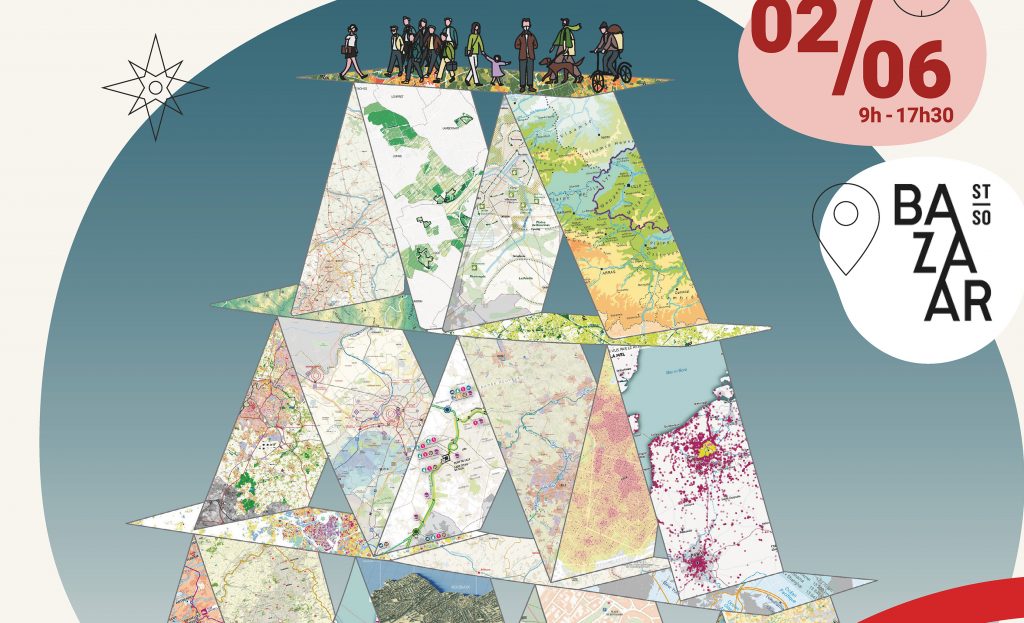
S’abstraire du réel afin de montrer l’invisible et représenter des phénomènes qui se mesurent mais ne se perçoivent pas, telle est l’une des principales vocations de la cartographie moderne. Mais les choses s’accélèrent, jusqu’à en devenir imprévisibles : climat, géopolitique, économie, démographie, technologie, etc. Alors que les transitions sont en cours, leur compréhension et leur anticipation sont rendues difficiles par cette accélération. Cela interroge la place qu’occupe la cartographie dans la représentation de ces changements.

La cartographie, en tant qu’outil, méthode et discipline, peut-elle se réinventer et dépasser les limites de sa grammaire, pour représenter le monde anthropocène et les transitions en cours ? À travers sa pratique actuelle, la cartographie peut-elle appréhender les défis environnementaux qui nous percutent ? Comment se met-elle au service de nos territoires pour aider à l’analyse, à la décision et la mise en lumière des nombreuses transitions auxquelles nous devons faire face ?

Plus de renseignements et inscriptions, sur le site de l’agence d’urbanisme de Lille, Adulm

Autres événements de la FNAU

  • Webinaire consacré aux enjeux de renaturation des territoires

    Webinaire consacré aux stratégies territoriales de renaturation 25 septembre de 10h à 12h Inscrivez-vous Depuis fin 2023, la Fnau, l’Ademe et l’OFB ont engagé une réflexion commune sur la renaturation, en lien avec la DGALN, la...

    En savoir plus...
  • Promotional poster for Webinar 4 of the Fnau 2025 webinar series, with the visual divided between textual information and speaker portraits on the left, and a metaphorical photograph of a miniature wooden railway network on the right; This playful scene features a red-and-white toy station labeled “FUTURE STATION” (translated as “Gare du Futur” in French), a wooden train with a red locomotive and yellow carriage, and a small wooden figurine placed near the tracks. The miniature setup symbolically represents the concept of planning and designing future transport infrastructure in a tangible and accessible way; The text announces the date and time of the event, July 4, 2025, from 10:00 to 12:00, and specifies that registration is required. The main title reads: “Transport Hubs: Integrating Mobility, Connecting Territories”, highlighting the focus on multimodal transport hubs and interconnectivity between urban, suburban, and rural areas. The accompanying slogan, “Planning with Serm: Putting Territories on the Right Track”, emphasizes the role of Serm (Services Express Régionaux Métropolitains – Regional Express Transport Services) in shaping sustainable and efficient territorial mobility in France; The poster lists the speakers, providing their roles to contextualize their expertise for an international audience: Cathy Savourey, Deputy Mayor of Tours and President of the ATU (Agence d’urbanisme de l’agglomération de Tours – Urban Planning Agency of the Tours Metropolitan Area), representing local urban planning perspectives; Hiba Debouk, Deputy Director, Territories, Arep (Architecture, Research, Engineering, Planning), a French consultancy specializing in transport and urban design; Sabine Roux, Serm Project Manager, Cerema (Centre for Studies and Expertise on Risks, Environment, Mobility and Urban Planning), a public research and expertise center in France; Pierre Landau, Director of Development at Vinci Autoroutes, Cofiroute network, a major private operator of French highways; The event was co-hosted by Sébastien Pividal, Director General of ATU, and Brigitte Bariol Mathais, Director General of Fnau, emphasizing collaboration between local authorities and national urban planning institutions. The webinar was organized with the support of three French ministries: Ministry of Territorial Planning – responsible for national land use and urban planning policies; Ministry of Ecological Transition and Territorial Cohesion – responsible for environmental policy, sustainable transport, and regional development; Ministry of the Sea – responsible for maritime affairs and the management of coastal and port areas. This visual and the webinar aim to make the complex topic of integrated transport hubs accessible, illustrating how local, regional, and national actors collaborate to develop sustainable mobility solutions across French territories.

    Webinaire 4. Serm : Les pôles d’échanges – articuler les mobilités, relier les territoires

    Dans le cadre du cycle de webinaires consacré aux Serm, la Fnau propose un temps d’échange dédié aux pôles d’échanges multimodaux, en partenariat avec la DGALN et la DGITM. Les Serm visent à construire un système de transport...

    En savoir plus...
  • Cycle de webinaires. Aménager avec les Serm, mettre les territoires sur de bons rails.

    Les Serm sont au cœur des enjeux d’aménagement, à la fois à l’échelle des grandes aires métropolitaines et pour l’aménagement urbain à l’échelle des quartiers. Ils sont appelés à jouer un rôle crucial dans la structuration de...

    En savoir plus...